"I object to violence because when it appears to do good, the good is only temporary; the evil it does is permanent."
Mahatma Gandhi
Thursday, May 25, 2006


Monday, May 22, 2006
THANKS!
THANKS!
I thank everyone who made the Downtown Bloomington Farmer's Market opening day a success; the consumers, the producers and all those folks who work hard behind the scenes to make it all happen. I was excited to be back and it was really nice to see so many familiar faces. The whole morning served as a great shot of encouragement for what I'm trying to do.
I had been so busy planting lately that I had hardly looked back to notice how things were coming along. I was pleasantly surprised (and a bit relieved) to find more to harvest than expected. In fact, I didn't get to everything I had hoped. Maybe next week.
Just a recap of this week and a preview of next week:
Last week we offered baby spinach, lettuce, woodland greens mix (very nutritious!), german red garlic greens, cherokee garlic greens, radishes, baby radishes, gobu, goosegrass, green onions, mustard seed pods, sweet cicely and sage.
This week we plan to have all of the above and... radish seed pods, mustard greens, pea tendrils, chickweed and pennycress.
Egg Shares
Egg shares generated a lot of interest at the market. We still have some shares left. This Fall when the new pullets start laying I will have a lot more eggs. Until then, the supply is pretty limited, so as the radio announcer says, "Get yours today!". For more on egg shares, click on the Egg Shares link on the right.

More Market
We have confirmed an arrangement with Latte Time Coffee Shop in Normal to set up our produce stand in their lot. they are on Main Street in Normal just North of the Mcdonald's and ISU parking lot. Tentatvely, I will be set up there Saturday after the downtown Bloomington market ends and Tuesdays starting in June. Hope to see you there!
Flock Shares
With the help of Ma and Ted "the Master Gutter", we dressed the first of our broilers yesterday. The process went very smooth. I personally thanked each bird before sending him or her on it's way. Ted has years of experience dressing thousands of birds and I'm thankful for his valuable lessons. Even he was impressed with the tub style plucker we used (Thanks to The Land Connection for making it's use possible). Ma fried one up that night along with some livers. I can't describe how wonderful a fresh, pastured, organically-fed broiler tastes. You'll just have to find out for yourself! I will be offering some of the remaining broilers as part of a flock share. Similar to the Egg Shares or other CSAs, the flock share invites consumers to invest in the broiler production. Each share entitles the shareholder to 4 broilers. Each share is $60. These birds are dressing out at 4-6 lbs each and are incredibly tender and juicy!
I have found the local organic pasture fed birds to be far superior to anything coming from the factory farms. There is also no worry about growth hormones, antibiotics or toxic living conditions.
Email jake@grandprairiefood.com for more info or feedback on Flock Shares or Egg Shares.
While I'm at it...
I just have to thank those who have shown up to help out in the field so far; Kevin, Jared, Randy and Mary. It is very encouraging to have others join in. Every little bit helps.
I thank everyone who made the Downtown Bloomington Farmer's Market opening day a success; the consumers, the producers and all those folks who work hard behind the scenes to make it all happen. I was excited to be back and it was really nice to see so many familiar faces. The whole morning served as a great shot of encouragement for what I'm trying to do.
I had been so busy planting lately that I had hardly looked back to notice how things were coming along. I was pleasantly surprised (and a bit relieved) to find more to harvest than expected. In fact, I didn't get to everything I had hoped. Maybe next week.
Just a recap of this week and a preview of next week:
Last week we offered baby spinach, lettuce, woodland greens mix (very nutritious!), german red garlic greens, cherokee garlic greens, radishes, baby radishes, gobu, goosegrass, green onions, mustard seed pods, sweet cicely and sage.
This week we plan to have all of the above and... radish seed pods, mustard greens, pea tendrils, chickweed and pennycress.
Egg Shares
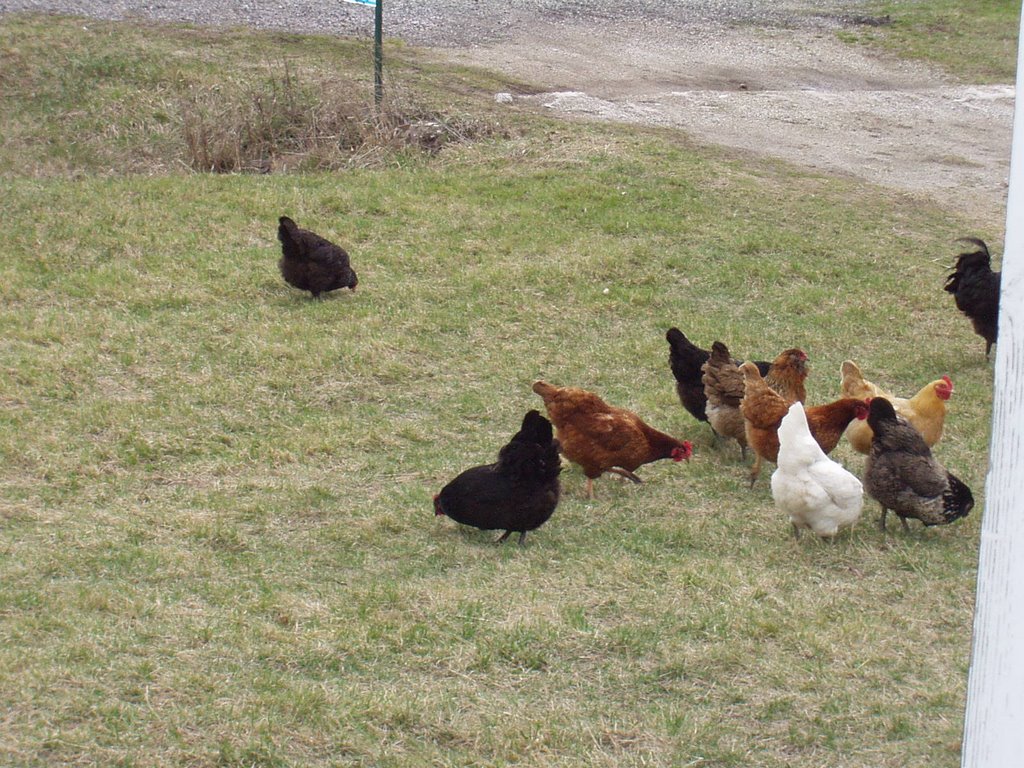
Egg shares generated a lot of interest at the market. We still have some shares left. This Fall when the new pullets start laying I will have a lot more eggs. Until then, the supply is pretty limited, so as the radio announcer says, "Get yours today!". For more on egg shares, click on the Egg Shares link on the right.
More Market
We have confirmed an arrangement with Latte Time Coffee Shop in Normal to set up our produce stand in their lot. they are on Main Street in Normal just North of the Mcdonald's and ISU parking lot. Tentatvely, I will be set up there Saturday after the downtown Bloomington market ends and Tuesdays starting in June. Hope to see you there!
Flock Shares
With the help of Ma and Ted "the Master Gutter", we dressed the first of our broilers yesterday. The process went very smooth. I personally thanked each bird before sending him or her on it's way. Ted has years of experience dressing thousands of birds and I'm thankful for his valuable lessons. Even he was impressed with the tub style plucker we used (Thanks to The Land Connection for making it's use possible). Ma fried one up that night along with some livers. I can't describe how wonderful a fresh, pastured, organically-fed broiler tastes. You'll just have to find out for yourself! I will be offering some of the remaining broilers as part of a flock share. Similar to the Egg Shares or other CSAs, the flock share invites consumers to invest in the broiler production. Each share entitles the shareholder to 4 broilers. Each share is $60. These birds are dressing out at 4-6 lbs each and are incredibly tender and juicy!
I have found the local organic pasture fed birds to be far superior to anything coming from the factory farms. There is also no worry about growth hormones, antibiotics or toxic living conditions.
Email jake@grandprairiefood.com for more info or feedback on Flock Shares or Egg Shares.
While I'm at it...
I just have to thank those who have shown up to help out in the field so far; Kevin, Jared, Randy and Mary. It is very encouraging to have others join in. Every little bit helps.
Saturday, May 13, 2006
Egg Shares Available
The rainy weather is keeping me out of the garden so I'm spending a little time on marketing. If I haven't mentioned it before the organization's name for production is Gardens Of Organic Diversity (GOOD). Gardens, plural, since both my uncle and brother are caring for their own gardens and are included in production and experimentation. Would love to have other gardens included.
I didn't want to market anything until I was sure I could produce it. So far, eggs seem to be the one thing I am sure I am able to offer, thanks to the girls, of course. Much like Community Supported Agriculture (CSA) we are offering egg shares. Read below for the details. Thanks.
Gardens Of Organic Diversity - Egg Shares
ɵ Pastured ɵ Organically Fed ɵ Always FRESH ɵ Consumer Inspected
How does the Egg Share work?
Similar to a CSA (community supported agriculture), individuals are invited to invest in our chicken egg operation. Shares are purchased for an agreed upon price. Each Egg Share entitles the individual to 30 dozen eggs over the course of 3 seasons (Spring, Summer, Fall)*. We are guaranteed a consumer for what we produce and you are guaranteed a fresh product at a low set price.
How do I get my eggs?
We will be offering delivery to the Bloomington Downtown Farmer’s Market on Saturday mornings and to the Normal area on Tuesdays. Other delivery dates, times and locations will be announced later.
How are the chickens raised?
They free range on pasture and are supplemented with local, organic layer feed. Come out and see them for yourself. We will regularly invite Egg Share holders to visit the flocks. We also like to post pictures of our birds. We’re quite proud.
Email jake@grandprairiefood.com if you have any questions or would like to purchase shares.
2006 Egg Shares are limited. Prices are $90 per share; $48 per 1/2 share; and $170 for two shares.
I accept cash, check, money order, paypal, VISA, MC and AMEX.
Check back soon for information on flock shares and how you can enjoy some organic, pasture raised broilers.
 Part of the flock on a sunny day last January.
I didn't want to market anything until I was sure I could produce it. So far, eggs seem to be the one thing I am sure I am able to offer, thanks to the girls, of course. Much like Community Supported Agriculture (CSA) we are offering egg shares. Read below for the details. Thanks.
Gardens Of Organic Diversity - Egg Shares
ɵ Pastured ɵ Organically Fed ɵ Always FRESH ɵ Consumer Inspected
How does the Egg Share work?
Similar to a CSA (community supported agriculture), individuals are invited to invest in our chicken egg operation. Shares are purchased for an agreed upon price. Each Egg Share entitles the individual to 30 dozen eggs over the course of 3 seasons (Spring, Summer, Fall)*. We are guaranteed a consumer for what we produce and you are guaranteed a fresh product at a low set price.
How do I get my eggs?
We will be offering delivery to the Bloomington Downtown Farmer’s Market on Saturday mornings and to the Normal area on Tuesdays. Other delivery dates, times and locations will be announced later.
How are the chickens raised?
They free range on pasture and are supplemented with local, organic layer feed. Come out and see them for yourself. We will regularly invite Egg Share holders to visit the flocks. We also like to post pictures of our birds. We’re quite proud.
*No more than 2 dozen eggs can be picked up at one time per Egg Share. If you think you might need more eggs you can purchase multiple Egg Shares. If for any unforeseen reason we are unable to provide all 30 dozen we will provide a refund on undelivered eggs.
Email jake@grandprairiefood.com if you have any questions or would like to purchase shares.
2006 Egg Shares are limited. Prices are $90 per share; $48 per 1/2 share; and $170 for two shares.
I accept cash, check, money order, paypal, VISA, MC and AMEX.
Check back soon for information on flock shares and how you can enjoy some organic, pasture raised broilers.
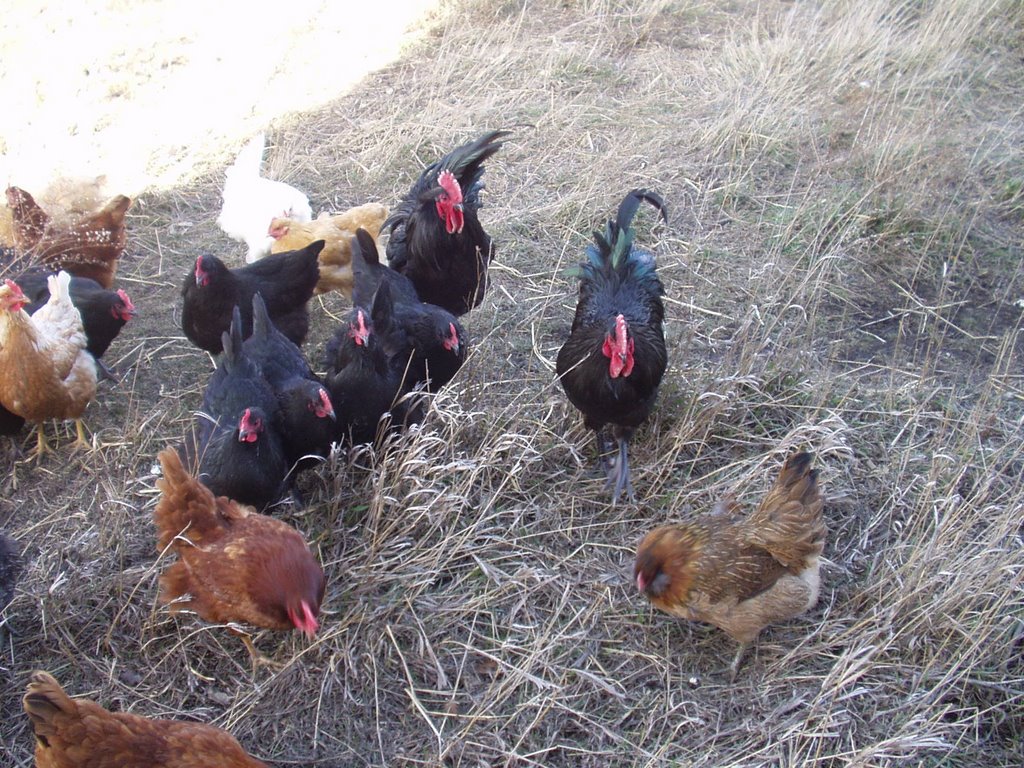 Part of the flock on a sunny day last January.
The Piled Pullet That Pulled Through
She made it. After an hour or so she was moving her head and opening her eyes for short periods. I could not interest her in any food or water. I kept the fire going and kept rotating the bricks. At one point I rolled her over onto a dry part of the towel and she decided to sit up. After a brief look around she tucked her head and went back to sleep. She would chirp whenever she heard me approach or walk away. Some time later she soiled the towel so I decied to move her to a box with the warm bricks and some food and water. She slept a couple more hours. About 3:30 she came out of the box walking around. I went over and pecked at the food with my finger and she quickly went to work at it herself. She was clearly recovered. She was intent on leaving the box to explore the front room so I decided to move her to the garage. Later, she got in a broiler box with the chicks so I moved her to the breezeway which was dark at the time meaning she would go to sleep. This morning she seems fine. I am letting her stay in the garage again until the weather warms a bit, maybe Monday.
When I picked her up I thought she was dead and even when I discovered she was alive I gave her a slim chance of surviving. Now it looks as if she'll live out her life as an egg layer. If she can only avoid the pitfalls of farm life for 10-12 more weeks.
When I picked her up I thought she was dead and even when I discovered she was alive I gave her a slim chance of surviving. Now it looks as if she'll live out her life as an egg layer. If she can only avoid the pitfalls of farm life for 10-12 more weeks.
Friday, May 12, 2006
More Cold Weather & Rain
Ahhhh, Spring on the Grand Prairie! The rain we could definitely use though my peppers and toms don't care for this cold weather any. It's the chicks I'm most worried about. The new arrivals are snug inside their brooder boxes but the 7 1/2 week olds are outside. The broilers should be okay but the others just made it out in the last week. I took extra steps with some hay bales and wood to protect them against the wind and rain. I'm tempted to make a fire myself.
----
I wrote the above before retiring last night. This morning when I checked everyone seemed fine but on closer inspection I found two black austrolorp pullets on the ground apparantly piled from last night. When I removed them I noticed one had it's eyes partly open and sure enough it was alive. I tucked her into my coat right away to shield her wet and trampled body from the wind. I brought her in, wrapped her in a towel and set her on the chair by the fire. I mixed some maple syrup, warm water and acv (apple cider vinegar) for quick energy. She was unconscious so I just tried putting a couple drops on her beak. I noticed her breathing strengthen as I sat with her on my lap holding warm bricks from the stovetop against her and cupping her very cold feet in my hands. I just set her down a minute ago. She was starting to move her head a little and her feet are shivering beneath the towel. I hope this is a sign she is warming and recovering. When I found her she was immobile and looked just like her dead sister. She has a spot of fresh blood near her ear. Cannot tell if this is external or from internal cause. She may survive the hypothermia only to succumb to injuries.
Just checked again and her breathing is definitely stronger and more steady.
She has met my last 3 approaches with small chirps, a good sign.
----
I wrote the above before retiring last night. This morning when I checked everyone seemed fine but on closer inspection I found two black austrolorp pullets on the ground apparantly piled from last night. When I removed them I noticed one had it's eyes partly open and sure enough it was alive. I tucked her into my coat right away to shield her wet and trampled body from the wind. I brought her in, wrapped her in a towel and set her on the chair by the fire. I mixed some maple syrup, warm water and acv (apple cider vinegar) for quick energy. She was unconscious so I just tried putting a couple drops on her beak. I noticed her breathing strengthen as I sat with her on my lap holding warm bricks from the stovetop against her and cupping her very cold feet in my hands. I just set her down a minute ago. She was starting to move her head a little and her feet are shivering beneath the towel. I hope this is a sign she is warming and recovering. When I found her she was immobile and looked just like her dead sister. She has a spot of fresh blood near her ear. Cannot tell if this is external or from internal cause. She may survive the hypothermia only to succumb to injuries.
Just checked again and her breathing is definitely stronger and more steady.
She has met my last 3 approaches with small chirps, a good sign.
Sunday, May 07, 2006
Planting & Getting Ready For Market
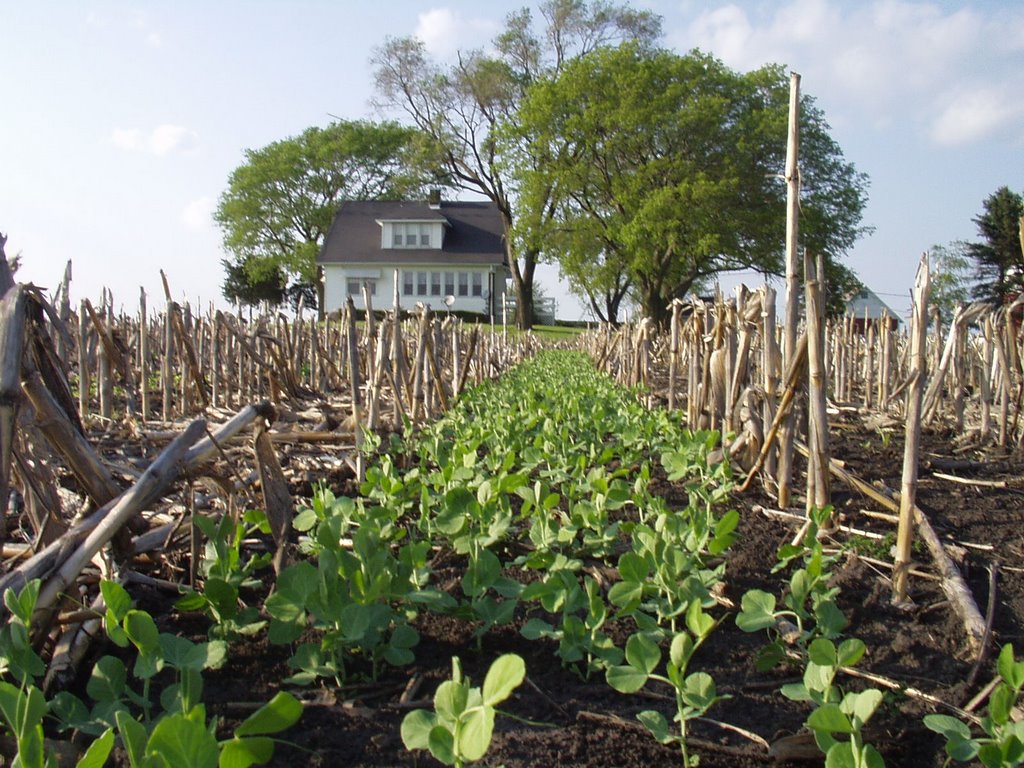
The title sums up what I've been doing since the last post. I don't like to use this excuse too often but "I've been real busy!"
With the help of my neighbor friend, Mary, and her kids (one of whom is my new helper)I got all of the potatoes in. I've also put out some pepper and tomato transplants, as well as more plantings of beans, greens, radishes, beets, etc. Our corn seed is untreated so we must wait for warm soil to plant. Gourds, pumpkins, melons and cukes will go in soon too. I have a lot of flower seed to go in too.
All of the chicks are out now. Still few losses. Something got at a pullet through their pen wire. It was only a small wound but enough to kill it. I noticed an injured wing on another. Obvious predator damage. I suspect the new cat who came home with me (unintentionally) in a load of feed . He also had been in the garage the night I lost 6 pullets to piling. It was not cold out and I had not had any other recent losses. I think the cat was up on their brooder cage causing a panic. When they pile in the corners the bottom ones can get killed. That is where I found the 6, dead but no predator damage. I now remember reading about making curved inserts for corners to help prevent this. Will try it with the new chicks coming.
I wanted to start marketing my produce in Bloomington yesterday, Saturday. I did not have a lot but enough to offer anyway. I had a bad experience the week before with a garage sale I held at my brother's. I was trying to raise a little cash since I've put about all available funds into the new garden venture. So I spent all this time getting ready and gas to get there only to make just enough to cover gas. And it cost me a day's planting to boot. I was afraid I would end with the same results in Bloomington with my small offering so I went with the sure thing and did a bunch of planting instead.
Still looking for any volunteers or cheap day laborers. Email me at jake@grandprairiefood.com if you want to come out to Flanagan and lend a hand. All the sunshine and fresh air you could want!
Tuesday, April 25, 2006
Cold Weather and Rain
The warm sunny weather has given way to cold and rain. Fortunately, my uncle and I wrapped up our new porch and I got 12 more rows in yesterday. The ground was definitely ready for some rain.
So far I have made 1 or more plantings of the following: peas, carrots, onions, beets, chard, spinach, lettuce, mustard, pok choi, green beans, radishes, kohlrabi and soybeans. My seed potatoes which were to ship the 1st week of april did not ship until the 19th and just arrived yesterday. I have 100 lbs ready to plant and 100 lbs. more to cut up. But the rain will hold planting up a couple of days.
The gladiolus are due this week too.
The cornish broilers made it outside last week. The weather was nice and they had a lot of feathers so I decided to get them out. They were clearly digging it. Not so much so today with the wind and rain. They have a moveable pasture pen with half enclosed. I've also put some straw bales at the corner they sleep at.
I took a look at the clover/ alfalfa/ rye pasture my cousin and I planted late last winter. Germination seems to be good. Once it is more developed chickens will go on it. right now it looks like corn stubble with a lot of green in the rows.
Speaking of corn stubble, what once seemed a hindrance is now considered a boon. Besides marking the rows and paths and providing mulch and organic matter to the soil, I notice the spiders like to make their webs between it. Imagine rows of gossamer all over the field!
Well, the rain is giving me a chance to indulge in some reading and catch up on some much needed housework. Better take advantage.
Oh yeah, Thursday is potato planting day. Email me at jake@grandprairiefood.com if you want to come out to Flanagan and pitch in.
So far I have made 1 or more plantings of the following: peas, carrots, onions, beets, chard, spinach, lettuce, mustard, pok choi, green beans, radishes, kohlrabi and soybeans. My seed potatoes which were to ship the 1st week of april did not ship until the 19th and just arrived yesterday. I have 100 lbs ready to plant and 100 lbs. more to cut up. But the rain will hold planting up a couple of days.
The gladiolus are due this week too.
The cornish broilers made it outside last week. The weather was nice and they had a lot of feathers so I decided to get them out. They were clearly digging it. Not so much so today with the wind and rain. They have a moveable pasture pen with half enclosed. I've also put some straw bales at the corner they sleep at.
I took a look at the clover/ alfalfa/ rye pasture my cousin and I planted late last winter. Germination seems to be good. Once it is more developed chickens will go on it. right now it looks like corn stubble with a lot of green in the rows.
Speaking of corn stubble, what once seemed a hindrance is now considered a boon. Besides marking the rows and paths and providing mulch and organic matter to the soil, I notice the spiders like to make their webs between it. Imagine rows of gossamer all over the field!
Well, the rain is giving me a chance to indulge in some reading and catch up on some much needed housework. Better take advantage.
Oh yeah, Thursday is potato planting day. Email me at jake@grandprairiefood.com if you want to come out to Flanagan and pitch in.
Saturday, April 15, 2006
Bad Day For the Chickens
Wednesday was an unfortunate day for the chickens during which two died practically in my arms in completely seperate incindents.
I went to gather eggs from the reds in late morning. One hen was in her nest box and when I reached under her she was wet with blood. I noticed she was also woozy. As I picked her up, another hen pecked at her abdomen. There was a small wound there. Apparantly, she injured herself on something or perhaps was wounded by a predator through the wire floor. Once a chicken has a wound it will attract the others, especially if the birds are confined and the wounded bird has less chance to be alone. I could see that there was nothing I could do for her except make her comfortable so I brought her in. She died within half an hour.
Having survived most of the winter with the flock intact, (I only lost one in late winter, hit by a car, that makes 2 to the road), it was upsetting to lose another. I felt I should have been more attentive but many things have drawn my attention lately. With a feeling of negligence, I decided to drop what I was doing and do a head count on the rest of the flock. I noticed right away one rooster was missing and they are the ones I worry about the least considering their size. I started a search and soon I could tell there were two distinct areas crowing was coming from. I could spot the one rooster but not the other. I finally pinpointed the area of crowing. The rooster, Little Boss, and a black hen had gone in one end of a roll of wire fence which dead ended at an old milk can. They went in but couldn't back out and had been there for 3-4 days. I got them out immediately. The rooster could barely walk and the hen could barely stand. I got some water and maple syrup mixed up to give them some quick energy. I had to dip their beaks to get them to drink. The rooster resisted which gave me hope he would make it. I cracked an egg for each of them but the hen would not eat. The rooster did and seemed to be regaining himself by that afternoon. The hen did not do as well. I helped her drink occassionally and left food in front of her in a sheltered spot in the perch house. When I checked on her later she was droopy with little response. I now thought to do what I should have done earlier. I mixed up some fine ground chick starter, some honey and some water and tried to feed her with a syringe to no avail. She died shortly after.
The worst part is her death was completely avoidable. The previous weekend my uncle and cousins were out. While my uncle and I were talking one of my younger cousins asked me about the chickens getting stuck in the fence. Without even investigating, I dismissed the idea. The fence had been there for a couple weeks now and I didn't think it posed any threat. I didn't even look or I would have seen the dead end trap I HAD SET. John must have thought I knew what I was talking about because he didn't push the issue and I continued my conversation.
I am now more vigilant than ever about inspecting the birds.
I went to gather eggs from the reds in late morning. One hen was in her nest box and when I reached under her she was wet with blood. I noticed she was also woozy. As I picked her up, another hen pecked at her abdomen. There was a small wound there. Apparantly, she injured herself on something or perhaps was wounded by a predator through the wire floor. Once a chicken has a wound it will attract the others, especially if the birds are confined and the wounded bird has less chance to be alone. I could see that there was nothing I could do for her except make her comfortable so I brought her in. She died within half an hour.
Having survived most of the winter with the flock intact, (I only lost one in late winter, hit by a car, that makes 2 to the road), it was upsetting to lose another. I felt I should have been more attentive but many things have drawn my attention lately. With a feeling of negligence, I decided to drop what I was doing and do a head count on the rest of the flock. I noticed right away one rooster was missing and they are the ones I worry about the least considering their size. I started a search and soon I could tell there were two distinct areas crowing was coming from. I could spot the one rooster but not the other. I finally pinpointed the area of crowing. The rooster, Little Boss, and a black hen had gone in one end of a roll of wire fence which dead ended at an old milk can. They went in but couldn't back out and had been there for 3-4 days. I got them out immediately. The rooster could barely walk and the hen could barely stand. I got some water and maple syrup mixed up to give them some quick energy. I had to dip their beaks to get them to drink. The rooster resisted which gave me hope he would make it. I cracked an egg for each of them but the hen would not eat. The rooster did and seemed to be regaining himself by that afternoon. The hen did not do as well. I helped her drink occassionally and left food in front of her in a sheltered spot in the perch house. When I checked on her later she was droopy with little response. I now thought to do what I should have done earlier. I mixed up some fine ground chick starter, some honey and some water and tried to feed her with a syringe to no avail. She died shortly after.
The worst part is her death was completely avoidable. The previous weekend my uncle and cousins were out. While my uncle and I were talking one of my younger cousins asked me about the chickens getting stuck in the fence. Without even investigating, I dismissed the idea. The fence had been there for a couple weeks now and I didn't think it posed any threat. I didn't even look or I would have seen the dead end trap I HAD SET. John must have thought I knew what I was talking about because he didn't push the issue and I continued my conversation.
I am now more vigilant than ever about inspecting the birds.
Monday, April 10, 2006
Introducing the Girls
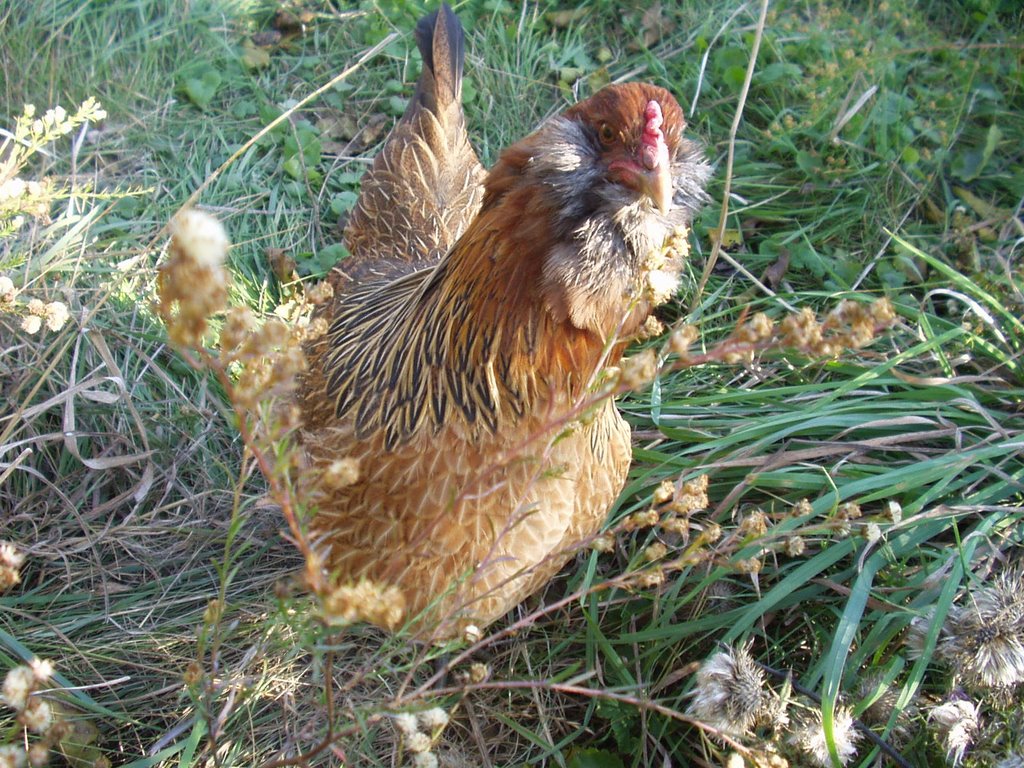
Many people enjoyed fresh eggs from my small flock of chickens last year. The girls just turned one year old on March 31st and are coming into high production this year. More on how you can enjoy eggs from this organically fed, free range flock later. The flock is primarily Black Austrolorp hens with a few Buff Orpingtons, Rhode Island Reds, Golden Comets and Araucanas (one is Phoenix, pictured above) mixed in. I was so pleased with the hardiness and disposition of the Black Austrolorps that when I decided to increase my flock this year I chose them again. There are 2 large Black Austrolorp roosters keeping watch over the girls. With a current ratio of 1 rooster to 14 hens, there is no fighting between them. But there is definitely a dominant one (more on Big Boss later). They are all beautiful birds!
Out of the Frying Pan...
This winter some red pullets escaped from a local farmer who also has a hunting club. I was told they were on their way to the frying pan soon so one night (with the farmer's permission) my uncle, cousins and I found a bunch roosting and rounded up 22 birds. I kept 15 and put them in a pen isolated from my flock. The other 7 went to one of my brothers to start his small flock. The 15 I kept have since been moved to a run with attached nest/ perch house and switched to fresh, high quality organic chicken feed. The run is moved about once a week to give them fresh pasture. Their actions enhance the soil. They are also great layers!
The Next Generation
The eggs from my flock were so popular last year I knew I would have to get more birds if I wanted to satisfy demand. Having been off of store bought chicken for years now, I also wanted to raise some for eating. So this Spring I ordered more chicks: 100 black austrolorp pullets, 50 cornish cross broilers and 50 mixed standard breed cockerels (for butchering). They wer all hatched out on the last day of Winter. There have only been very slight losses but still it is disappointing to lose a chick. This is only my 2nd attempt at raising chicks. {Last year I successfully raised 52 out of 52. I didn't lose a bird until I butchered an extra rooster at about 10 weeks.} If all continues to go well, I will order more chicks later in the Spring.
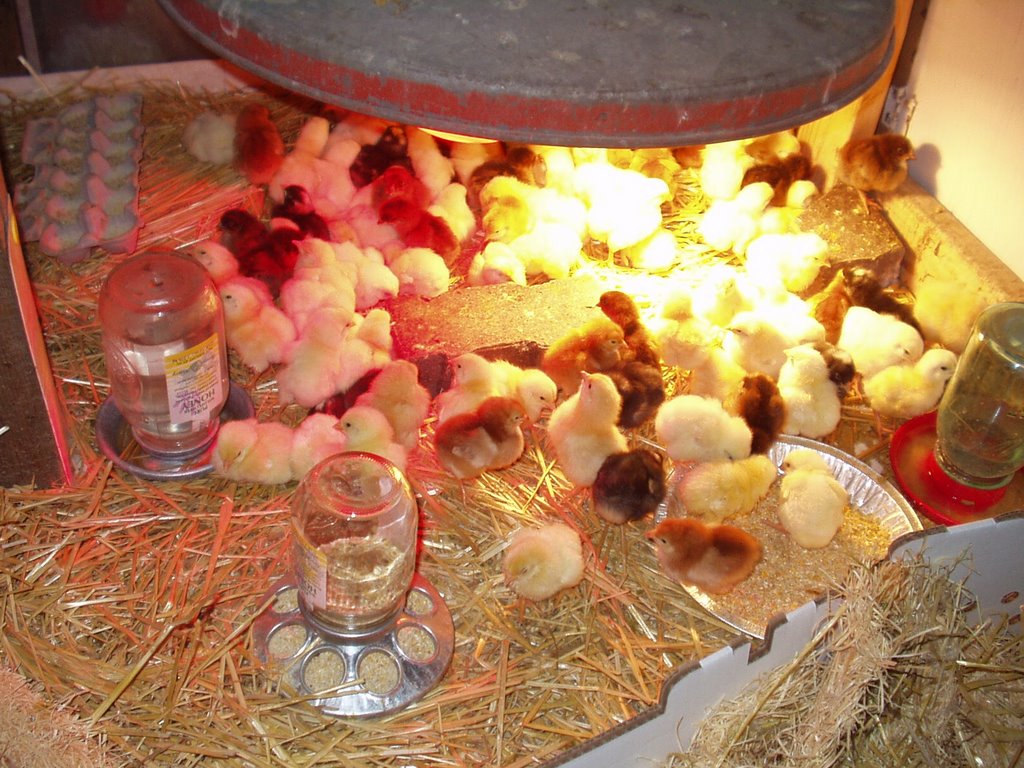
Are you interested in keeping chickens? Let me know and I may be able to provide you with some organically raised chicks and organic chicken feed.
Wednesday, April 05, 2006
Warm Weather and Rain
The past week has brought a blessing of warm weather and rain. More lettuce, spinach, peas, beets and radishes have been planted. The garlic and flower bulbs planted last fall are coming up nicely. The seedlings in my small greenhouse aren't faring so well. Still working on stabilizing the temperature. Also with all the high winds it has been kept inside the garage door. The opaque door cuts down the light and they are straining forward. I have ordered a few organic transplants for delivery in May as an 'ace in the hole'. If it turns out there are extra transplants I plan to make them available. After all, the long term plan is to get as many people as possible to produce food.
Calling for more rain tomorrow so I hope to get more peas planted today. All of the other peas have been planted into unworked ground. I'm going to loosen a row with the fork and plant these ones.
Calling for more rain tomorrow so I hope to get more peas planted today. All of the other peas have been planted into unworked ground. I'm going to loosen a row with the fork and plant these ones.
Saturday, April 01, 2006
Familiar Face?

This was a photo taken by a customer last Fall at the Downtown Bloomington Farmer's Market. She was kind enough to share a copy. I had folks taking photos of the beautiful display almost every week. Of course, I can't take credit for all the wonderful produce. I'm grateful to God for providing us with Mother Earth who generously grants us this Grand Prairie with it's vital soil. My Uncle Donn, Ben Lubchansky, Ioeger Family Farms, and The Land Connection also played a big part. Thanks again to all!
If you are new to my efforts then let this photo serve as an introduction: one scruffy dirt-hugger delivering fresh, organically grown produce to local consumers. For past customers, perhaps this photo will jog your memory. Hope to see you all again at the market and look forward to meeting more new people!
Thursday, March 30, 2006
To Till or Not To Till
30 mar 06
Last Monday my uncle and I made the 2nd planting of peas (Oregon Giant and Sugar Ann), 1st planting of kale, lettuce, radishes, spinach, chard, bunching onions, ...I forgot the beet seeds at home. We are using the stick seeder from Johny’s for our larger seeds such as peas. You have to watch it doesn’t jam and that the seed is feeding but so far, so good. I think it will be especially useful when I am doing long rows of corn.
This week I’m told again how crazy I am to try growing vegetables without tilling. I’m told I will fail miserably and what I need to do is get a tractor out there to till it. Except where I worked the ground with a fork for garlic and flower bulbs last fall, I have not done anything to the soil except rake back the corn litter. The soil is loose and I can make a furrow with a hoe very easily. I will use the fork or broadfork for some other crops as well but no heavy equipment.
I can see a lot of the finer parts of corn litter mixed in the top layer. I used the stick planter to plant some peas right through the litter. I think all those husks and cobs might make good mulch. Last year's stubble works to my advantage forming nice 30" rows and paths the whole length of the fields.
The ground to me looks superb but I suspect it has problems from years of conventional farming. I left the corn stubble and litter in the field all winter. Some farmers do that but most seem to plough in the fall. When the fields are ploughed it directly exposes a lot of the topsoil to the sun, wind and rain causing drying and erosion. I’m reminded of the topsoil sometimes seen clinging to snow drifts along fields in winter. Many microorganisms that thrived several inches below ground are also exposed to the surface elements along with the soil.
In contrast, the unploughed fields appear yellow with all the corn litter and the dark soil is scarcely visible through it. Soil macro-organisms such as worms seem to prefer this type of buffer between them and the elements. Indeed, as I raked back the corn litter to plant seed, I noticed several worm tunnels. The stubble holds the soil in place and the husks and other litter shield the soil from the elements.
Last Monday my uncle and I made the 2nd planting of peas (Oregon Giant and Sugar Ann), 1st planting of kale, lettuce, radishes, spinach, chard, bunching onions, ...I forgot the beet seeds at home. We are using the stick seeder from Johny’s for our larger seeds such as peas. You have to watch it doesn’t jam and that the seed is feeding but so far, so good. I think it will be especially useful when I am doing long rows of corn.
This week I’m told again how crazy I am to try growing vegetables without tilling. I’m told I will fail miserably and what I need to do is get a tractor out there to till it. Except where I worked the ground with a fork for garlic and flower bulbs last fall, I have not done anything to the soil except rake back the corn litter. The soil is loose and I can make a furrow with a hoe very easily. I will use the fork or broadfork for some other crops as well but no heavy equipment.
I can see a lot of the finer parts of corn litter mixed in the top layer. I used the stick planter to plant some peas right through the litter. I think all those husks and cobs might make good mulch. Last year's stubble works to my advantage forming nice 30" rows and paths the whole length of the fields.
The ground to me looks superb but I suspect it has problems from years of conventional farming. I left the corn stubble and litter in the field all winter. Some farmers do that but most seem to plough in the fall. When the fields are ploughed it directly exposes a lot of the topsoil to the sun, wind and rain causing drying and erosion. I’m reminded of the topsoil sometimes seen clinging to snow drifts along fields in winter. Many microorganisms that thrived several inches below ground are also exposed to the surface elements along with the soil.
In contrast, the unploughed fields appear yellow with all the corn litter and the dark soil is scarcely visible through it. Soil macro-organisms such as worms seem to prefer this type of buffer between them and the elements. Indeed, as I raked back the corn litter to plant seed, I noticed several worm tunnels. The stubble holds the soil in place and the husks and other litter shield the soil from the elements.
Monday, March 13, 2006
Grand Prairie
The natural division East and South of the Illinois River Valley is known by botanists and naturalists as the Grand Prairie. This vast plain was the former home of expansive tall grass prairies and great numbers of bison and waterfowl. For centuries this bioregion’s soil has fed those who live here and countless families across the continent and around the world. Although no longer as rich and vibrant as it once was, this soil continues to provide for humans today.
We strive to demonstrate sustainable farm practices that restore depleted soil and to share resources with producers and consumers. Proceeds from the club’s exchanges go to fund our efforts.
Tuesday, February 28, 2006
For those who have found this site
The purpose of this site will be to facilitate communication among FOOD club members. It will also serve as a blog of farm activities. A few such activities have already been started but I have decided to put off any lenghty entries until after March 21 when more planting will be done.
Until then this will remain fairly inactive. I may get a few links and lists up though.
Until then this will remain fairly inactive. I may get a few links and lists up though.
Subscribe to:
Posts (Atom)